Gold Mining in Ghana | Opportunities, Regulations & Growth
Gold mining in Ghana, for centuries, Ghana has been synonymous with gold. Once known as “The Gold Coast,” this West African nation continues to shine as Africa’s undisputed leader in gold production and a significant player on the global stage. If you’re looking to understand, invest in, or partner with a dynamic and rapidly evolving mining sector, Ghana presents an unparalleled landscape of opportunity.
In 2024, Ghana’s gold exports soared to a historic $11.6 billion, accounting for an astounding 57% of total export revenue and cementing gold’s position as the bedrock of the national economy. This remarkable performance, coupled with a projected production exceeding 5 million ounces in 2025, underscores the immense potential and robust growth trajectory of Ghana’s gold industry.
Beyond impressive figures, Ghana offers a compelling blend of established large-scale operations by global giants like AngloGold Ashanti and Newmont, alongside a vibrant and increasingly formalized artisanal and small-scale mining (ASGM) sector. The recent establishment of the Ghana Gold Board (GoldBod) in 2025 signifies a new era of enhanced regulation, transparency, and value addition, creating a more attractive and secure environment for all stakeholders. Gold mining in Ghana
Whether you are a potential investor seeking high-yield opportunities, a technology provider looking to innovate, or a partner interested in sustainable development, delve into Ghana’s gold industry. Discover a sector characterized by strong growth, significant economic impact, and a renewed commitment to responsible mining practices. The future of gold is gleaming in Ghana, and the opportunity to be part of this success story awaits.
Historical Context of Gold Mining in Ghana
Gold mining in Ghana has a rich and ancient history that dates back over a thousand years. The region was once known as the Gold Coast due to its vast gold resources, and became a central hub for trans-Saharan and later European trade. Long before colonization, indigenous communities practiced artisanal gold mining using rudimentary tools. Gold mining in Ghana
By the late 15th century, Portuguese traders arrived, drawn by the region’s gold wealth, followed by the British and other European powers. During the colonial period, especially under British rule, gold mining became more industrialized. The establishment of the Ashanti Goldfields Corporation in 1897 marked a turning point, turning Ghana into a focal point of Africa’s gold industry.
After gaining independence in 1957, Ghana gradually nationalized key mining assets, but in the 1980s and 1990s, the country liberalized its mining sector to attract foreign direct investment, leading to a boom in large-scale mining and renewed growth in artisanal and small-scale gold mining (ASGM).
Ghana’s Position in Global Gold Production
Today, Ghana is Africa’s largest gold producer and consistently ranks among the top 10 gold producers globally. It surpassed South Africa in 2018 to claim the top spot on the continent and has maintained that lead due to favorable investment policies, political stability, and a well-established mining infrastructure.
Major international companies such as Newmont, AngloGold Ashanti, and Gold Fields operate large-scale mines across the country. In parallel, Ghana has one of the most active and widespread artisanal gold mining sectors in Africa, contributing significantly to the country’s output.
Key Statistics (2024)
- Gold Export Revenue: In 2024, Ghana generated approximately $11.6 billion from gold exports, accounting for 57% of the country’s total export revenue. This underscores the central role gold plays in the national economy.
- Contribution to GDP: The mining and quarrying sector, with gold as the dominant mineral, contributes around 7-9% of Ghana’s GDP. Gold mining is thus a key driver of economic growth and foreign exchange.
Employment:
- The formal large-scale mining industry employs tens of thousands directly and supports many more through subcontracting and services.
- Importantly, the artisanal and small-scale gold mining (ASGM) sector employs over 1 million Ghanaians, making it one of the largest sources of rural employment in the country.
- ASGM is also a vital livelihood source, especially in regions like Ashanti, Western, Eastern, and Upper East regions. Gold mining in Ghana
NOTE. Ghana’s gold mining industry is not only a historical pillar of the country’s economy but also a modern engine of growth and employment. As Africa’s leading gold producer and a global top 10 player, Ghana continues to attract investment, support rural livelihoods, and generate crucial export revenue, though challenges such as illegal mining (galamsey), environmental concerns, and revenue management remain key areas for reform and policy focus.
Types of gold mining in Ghana
Gold mining in Ghana plays a major role in the country’s economy and has been practiced for centuries. Ghana is one of the top gold producers in Africa and globally. The gold mining sector in Ghana is generally categorized into two main types: large-scale (industrial) mining and small-scale (artisanal) mining. Each type has distinct characteristics, processes, and impacts.
- Large-Scale (Industrial) Gold Mining
Large-scale gold mining in Ghana is undertaken by multinational companies using advanced technology and heavy machinery. These operations are capital-intensive and subject to government regulation.
Key Features:
- Capital-intensive operations involving drilling, blasting, and processing.
- Licensed by the Minerals Commission of Ghana under the Minerals and Mining Act.
- Use of modern equipment such as excavators, crushers, and cyanidation plants.
- Higher environmental and safety standards compared to small-scale mining.
- Significant tax and royalty contributions to the Ghanaian government.
Major Large-Scale Mining Companies in Ghana:
- Newmont Goldcorp (Ahafo and Akyem mines)
- AngloGold Ashanti (Obuasi and Iduapriem mines)
- Gold Fields Ghana Limited (Tarkwa and Damang mines)
2. Small-Scale (Artisanal) Gold Mining
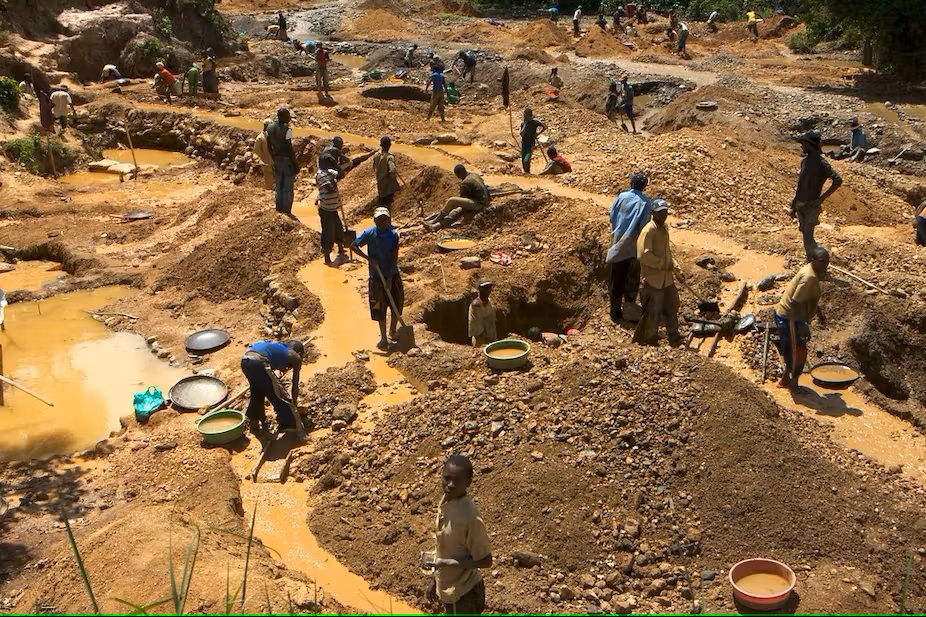
Small-scale or artisanal mining is a widespread form of gold mining in Ghana, involving individuals or small groups using basic tools and methods. It contributes significantly to rural employment and local economies.
Key Features:
- Operated by individuals or local groups, often with limited capital.
- Typically uses rudimentary methods, such as pickaxes, pans, sluices, and mercury amalgamation.
- Can be either licensed (legal) or unlicensed (illegal/“galamsey”).
- Often associated with environmental degradation and safety concerns.
- Key source of livelihood for many people in rural communities.
Subcategories:
- Licensed Small-Scale Mining: Recognized by the government and regulated under specific guidelines.
- Illegal Artisanal Mining (Galamsey): Unlicensed operations that often operate in protected areas or near large-scale concessions.
3. Alluvial vs. Hard Rock Mining (Applicable to Both Scales)
Gold mining in Ghana also differs based on the geology of the deposits:
Alluvial Gold Mining:
- Involves extracting gold from riverbeds, floodplains, or old river channels.
- Common among small-scale miners.
- Less expensive and easier to conduct.
- Often leads to river pollution due to the use of mercury and sedimentation.
Hard Rock (Lode) Gold Mining:
- Involves mining gold from solid rock formations.
- Requires blasting, crushing, and chemical extraction.
- More commonly practiced by industrial-scale operations.
- Surface vs. Underground Mining
Surface (Open-pit) Mining:
- Used when gold ore is located close to the surface.
- Involves removing large quantities of overburden.
- Common in large-scale mines like Tarkwa.
Underground Mining:
- Used when gold is located deep underground.
- Requires tunneling and advanced ventilation systems.
- Practiced at mines like Obuasi.
Note. Gold mining in Ghana encompasses a mix of modern industrial practices and traditional artisanal methods. While large-scale mining contributes significantly to national revenue, small-scale mining is crucial for local livelihoods. However, challenges such as illegal mining, environmental degradation, and safety issues persist, requiring balanced policies to ensure sustainable gold production.
Top Gold Mining Regions in Ghana
- Ashanti Region
Key Mining Areas: Obuasi, Konongo, Manso Nkwanta
- Obuasi is home to one of the richest gold mines in Africa – the Obuasi Gold Mine, operated by AngloGold Ashanti.
- Mining in the Ashanti region dates back centuries and continues to be a major hub for gold exploration.
- Both underground and surface mining are conducted here.
- The region is known for its high-grade ore and long-term reserves.
- Western Region
Key Mining Areas: Tarkwa, Prestea, Bogoso, Damang
- The Western Region is the largest gold-producing region in Ghana.
- Hosts some of the biggest mining companies, including Gold Fields Ghana (Tarkwa & Damang mines) and Golden Star Resources (Prestea-Bogoso).
- The area is rich in surface and hard rock gold deposits.
- Also a hotspot for small-scale (artisanal) mining, especially along riverbanks.
- Eastern Region
Key Mining Areas: Kibi, Osino, Akim Abuakwa
- Known for alluvial gold and small-scale mining.
- New exploration projects are underway, especially around Kibi.
- The Akyem Mine near New Abirem, operated by Newmont Ghana, is one of the largest in the country.
- The region also holds strategic importance for new investors and junior mining companies.
- Central Region
Key Mining Areas: Dunkwa-on-Offin, Twifo Praso, Assin Fosu
- Historically known for artisanal gold mining.
- Contains several small to medium-scale mining operations.
- The Offin River Basin is particularly rich in alluvial gold.
- The region has potential for future industrial exploration and development.
- Brong-Ahafo Region (Now Bono, Bono East & Ahafo Regions)
Key Mining Areas: Kenyasi, Ntotroso, Yamfo
- Home to Newmont’s Ahafo Mine, one of Ghana’s largest and most modern gold operations.
- Mining in this region is largely industrial, with limited artisanal activity.
- Rich in hard rock gold deposits and significant long-term mining potential.
- Upper East and Upper West Regions
Key Mining Areas: Bolgatanga, Wa, Tumu
- These are emerging gold mining regions in Ghana.
- Exploration is ongoing, with small-scale mining being the main activity currently.
- Companies like Cardinal Resources and Azumah Resources have reported promising gold deposits.
- These regions are expected to contribute more to Ghana’s gold output shortly. Gold mining in Ghana
Note. Ghana’s gold mining industry is geographically diverse, with the Ashanti and Western regions being the most productive. However, new exploration efforts in the Upper regions and Eastern belt are expanding the country’s mining footprint. These regions offer vast opportunities for both large-scale investors and local artisanal miners, making Ghana a central player in Africa’s gold economy.
Top Gold Mining Companies in Ghana
- Newmont Ghana Gold Ltd
- Mines: Ahafo Mine (Brong-Ahafo Region), Akyem Mine (Eastern Region)
- Type: Large-scale industrial
- Parent Company: Newmont Corporation (USA)
Overview:
Newmont is the largest gold producer in Ghana and one of the world’s top gold mining companies. Its Akyem and Ahafo mines are two of the most advanced and profitable gold operations in Africa.
- Notable Facts:
- Uses cutting-edge technology and environmental management systems.
- Provides significant employment and community development initiatives.
- AngloGold Ashanti Ghana Ltd
- Mines: Obuasi Mine (Ashanti Region), Iduapriem Mine (Western Region)
- Type: Underground and surface mining
- Parent Company: AngloGold Ashanti (South Africa)
Overview:
AngloGold Ashanti is a pioneer in Ghana’s gold sector, with historic ties to the Obuasi Gold Mine, one of Africa’s oldest and richest underground gold mines.
- Notable Facts:
- Obuasi mine was reopened in 2019 after years of redevelopment.
- Focuses on responsible mining and conflict-free gold sourcing.
- Gold Fields Ghana Ltd
- Mines: Tarkwa Mine, Damang Mine (Western Region)
- Type: Surface (open-pit) mining
- Parent Company: Gold Fields Limited (South Africa)
Overview:
Gold Fields is a leading player in Ghana’s gold mining sector. Its Tarkwa mine is one of the largest open-pit gold mines in Africa, producing over 500,000 ounces of gold annually.
- Notable Facts:
- Operates under high safety and environmental standards.
- Has invested heavily in local infrastructure and social projects.
- Asanko Gold Ghana Ltd (now part of Galiano Gold)
- Mine: Asanko Gold Mine (Ashanti Region)
- Type: Surface mining
- Parent Company: Galiano Gold (Canada) in joint venture with Gold Fields
Overview:
Asanko Gold is a relatively new entrant but operates a modern and rapidly growing mine in the Ashanti gold belt. The mine is known for efficiency and a strong production pipeline.
- Notable Facts:
- Strong focus on community engagement and transparency.
- Operates under a 50:50 JV with Gold Fields since 2018.
- Golden Star Resources Ltd
- Mines: Prestea and Wassa Mines (Western Region)
- Type: Underground and surface mining
- Parent Company: Chifeng Jilong Gold Mining Co. (China)
Overview:
Golden Star was historically a key mid-tier gold miner in Ghana until it was acquired by Chifeng Gold in 2022. The company is known for developing underground operations at Wassa.
- Notable Facts:
- Focuses on sustainable underground mining.
- Strong emphasis on worker safety and local hiring.
- Cardinal Resources Ltd
- Project: Namdini Gold Project (Upper East Region)
- Type: Open-pit (development phase)
- Parent Company: Shandong Gold Mining Co. (China)
Overview:
Cardinal Resources is developing one of Ghana’s largest undeveloped gold resources in the northern region, set to become a major new gold production hub.
- Notable Facts:
- Expected to produce over 200,000 ounces annually once operational.
- A key player in Ghana’s expanding northern mining frontier.
- Perseus Mining Ghana Ltd
- Mine: Edikan Gold Mine (Central Region)
- Type: Open-pit mining
- Parent Company: Perseus Mining Limited (Australia)
Overview:
Perseus operates the Edikan Gold Mine, a steady producer with a focus on cost-effective and sustainable operations.
- Notable Facts:
- One of the few Australian firms with a strong footprint in Ghana.
- Contributes to local training and skills development.
Note. Ghana’s gold mining industry is led by a combination of global mining giants and emerging developers, with Newmont, AngloGold Ashanti, and Gold Fields taking center stage. Together, these companies help make Ghana one of the top gold producers in the world, while also contributing to economic development, job creation, and infrastructure growth across the country.
Ghana’s Gold Mining Laws and Licensing Process
Ghana’s gold mining sector is regulated by a robust legal framework that ensures responsible mining, environmental protection, and revenue generation. The core legislation governing mining in Ghana is the Minerals and Mining Act, 2006 (Act 703), as amended.
Key Legal Framework for Gold Mining in Ghana
- Minerals and Mining Act, 2006 (Act 703)
This is the primary law regulating mining activities in Ghana. It covers licensing, royalties, environmental responsibility, local content, and dispute resolution.
Key Provisions:
- Ownership of minerals is vested in the state.
- Minerals Commission is responsible for granting mineral rights.
- Foreign companies must incorporate a local company under Ghanaian law before applying for a license.
- Environmental and community impact assessments are mandatory.
- Minerals Commission of Ghana
- The regulatory body responsible for the administration of mineral resources.
- Oversees licensing, monitoring of mining operations, and compliance enforcement.
- Works closely with the Environmental Protection Agency (EPA) and Ghana Revenue Authority (GRA).
Economic Impacts of Gold Mining in Ghana
- Major Contribution to National GDP
Gold mining plays a vital role in Ghana’s economic structure, contributing significantly to the country’s Gross Domestic Product (GDP). The mining and quarrying sector, dominated by gold, accounts for approximately 7% to 9% of Ghana’s GDP annually. This helps sustain macroeconomic stability and supports national development goals through infrastructure, health, and education funding.
- Foreign Exchange and Export Revenue
Gold is Ghana’s leading export commodity, generating substantial foreign exchange earnings. In 2024 alone, gold exports brought in around $11.6 billion, representing 57% of the country’s total export revenue. This inflow of foreign currency helps stabilize the Ghanaian cedi, reduces trade deficits, and supports government reserves.
3. Employment and Livelihoods
The gold mining sector is a major source of employment in Ghana. Large-scale mining companies employ tens of thousands directly and indirectly through subcontracting and local procurement. Meanwhile, the artisanal and small-scale gold mining (ASGM) sector employs over 1 million Ghanaians, especially in rural communities, providing livelihoods and reducing poverty in mining areas.
4. Local Development and Infrastructure
Mining operations often lead to the development of infrastructure such as roads, electricity, and water supply in mining regions. Mining companies also contribute to community development projects, including schools, clinics, and local economic empowerment programs through corporate social responsibility (CSR) initiatives and mineral royalties shared with local governments.
Types of Mining Licenses in Ghana
- Reconnaissance Licence
- Allows preliminary exploration (e.g., aerial surveys and mapping).
- Validity: 1 year (renewable).
- Does not permit physical prospecting or mining.
- Prospecting Licence
- Grants the right to search for minerals and determine commercial viability.
- Validity: Up to 3 years (renewable once).
- Allows drilling, sampling, and feasibility studies.
- Mining Lease (Large-Scale Mining)
- Required for commercial mining operations.
- Validity: Up to 30 years (renewable for another 30).
- Subject to environmental and social impact assessments.
- Applicant must have a feasibility report and business plan.
4. Small-Scale Mining Licence
- Reserved for Ghanaian citizens only.
- For operations on land not exceeding 25 acres (10 hectares).
- Can be granted to individuals, co-operatives, or registered Ghanaian companies.
- Requires application through District Mining Offices of the Minerals Commission.
5. Gold Export Licence
- Issued by the Precious Minerals Marketing Company (PMMC) or Bank of Ghana.
- Mandatory for anyone seeking to export gold legally from Ghana.
Licensing Process: Step-by-Step Guide
For Large-Scale Mining Companies:
- Company Registration
- Register with the Registrar General’s Department in Ghana.
- Must be a company limited by shares.
- Apply to the Minerals Commission
- Submit an application for a reconnaissance, prospecting, or mining lease.
- Include geological data, technical capacity, environmental plans, and proof of funds.
- EPA Permit
- Conduct and submit an Environmental Impact Assessment (EIA).
- Receive an Environmental Permit from the Environmental Protection Agency.
- Minerals Commission Review
- Due diligence on the application, background checks, and site verification.
- Parliamentary Ratification
- Large-scale mining leases must be approved by the Ghanaian Parliament.
- Operational Licenses
- Obtain mining operating permit, explosives permit (if needed), and work permits for expatriates.
How to Buy Gold Directly from Miners in Ghana
Buying gold directly from miners in Ghana can give you access to lower prices, better profit margins, and direct supply chains. However, it requires strict compliance with local laws and a good understanding of the market dynamics to avoid scams and legal issues.
- Understand the Legal Requirements
Before engaging in gold buying in Ghana, you must:
- Register a company with the Registrar General’s Department (especially if you’re a foreigner).
- Obtain a Gold Trading License from the Minerals Commission.
- Get a Gold Export License through the Precious Minerals Marketing Company (PMMC) or Bank of Ghana.
- Be aware that foreigners cannot engage in small-scale mining or gold trading without a Ghanaian partner or approved structure.
- Identify Licensed Small-Scale Miners
You can buy gold directly from licensed small-scale miners. These miners are regulated by the Minerals Commission and typically operate in Ghana’s gold-rich regions like:
- Western Region (Tarkwa, Prestea)
- Ashanti Region (Obuasi, Konongo)
- Eastern Region (Kibi, Osino)
- Central Region (Dunkwa-on-Offin)
- Ahafo Region (Kenyasi, Yamfo)
Tip: Ask for proof of their Small-Scale Mining License, site registration, and PMMC documentation to ensure they are legitimate.
- Verify Gold Authenticity Through PMMC
Before making any purchase, it’s essential to:
- Test and assay the gold at the PMMC laboratory.
- PMMC verifies the purity, carat, and weight of the gold.
- PMMC also acts as a mandatory channel for exporting gold out of Ghana.
Only gold certified by PMMC can be legally exported from Ghana.
- Negotiate the Price and Terms
Gold from miners in Ghana is usually sold at slightly below international spot prices. Pricing depends on:
- Quantity (grams, kilograms)
- Purity (typically 22K or 24K)
- Form (dust, nuggets, or bars)
- Logistics (buyer collection or miner delivery)
Tip: Always use a written purchase agreement that includes:
- Purity and weight
- Payment terms
- Delivery timelines
- Assay verification conditions
- Make Payments Safely
Avoid large cash transactions. Recommended payment methods:
- Bank transfers through Ghanaian banks
- Escrow accounts (especially for large deals)
- Payment after PMMC assay confirmation (preferred by serious buyers)
- Arrange for Gold Export (If Buying for Export)
To export gold from Ghana, you must:
- Work with PMMC, which oversees all legal gold exports.
Obtain the following:
- Export permit
- Assay certificate
- Customs clearance
- Pay all necessary taxes and royalties (5% royalty, export duties, etc.).
PMMC will handle airport shipment, documentation, and customs on behalf of the buyer/seller.
Common Pitfalls to Avoid
- Unlicensed sellers (illegal miners or “galamsey” operators)
- You risk arrest, seizure, or loss of funds.
- Gold scam agents or brokers
- Many fraudsters pose as miners or intermediaries. Always verify identities and documentation.
- Cash-only transactions
- Use secure payment channels and never pay in advance without gold assay.
- Exporting gold without PMMC
- This is illegal and can lead to confiscation by customs.
Summary: Steps to Buy Gold from Miners in Ghana
Action and steps to follow
1 Register a company and obtain trading/export licenses
2 Find licensed small-scale miners
3 Verify gold purity at PMMC
4 Negotiate fair pricing and terms
5 Make secure payment
6 Export legally through PMMC
Note. Buying gold directly from miners in Ghana is possible and profitable when done legally, transparently, and securely. Partnering with licensed miners, verifying gold with PMMC, and following all regulatory procedures are critical to avoiding scams and ensuring a smooth transaction.
For Small-Scale Miners (Ghanaian Citizens Only):
- Visit the District Office of the Minerals Commission
- Provide Identification and Proof of Citizenship
- Submit Site Plan & Environmental Management Plan
- Pay Application and Processing Fees
- Site Verification by Commission Officers
- Issuance of Small-Scale Mining License
- Valid for up to 5 years and renewable.
- Apply for a Gold Export License (if applicable)
Taxes, Royalties & Local Content Requirements
- Royalties: 5% of gross revenue from gold sales.
- Corporate Income Tax: 35% for mining companies.
- Local Content Law: Certain jobs, supplies, and services must be reserved for Ghanaians.
- Stability Agreements: Offered to companies investing over $500 million to ensure predictable fiscal terms.
Illegal Mining (Galamsey)
Ghana has faced serious challenges from illegal mining operations, locally known as galamsey. These are:
- Unlicensed and unregulated.
- Often harmful to the environment (e.g., mercury use, water pollution).
- Actively targeted by government task forces and policy reforms.
Legal mining ensures environmental safety, community benefits, and investor protection.
Note. Ghana’s gold mining laws are structured to support investment while promoting sustainability and local participation. Whether you’re a large-scale investor or a small-scale operator, compliance with the Minerals and Mining Act, proper licensing, and environmental responsibility are essential for legal and profitable operations.
Challenges in gold mining in Ghana
- Illegal Mining (Galamsey)
Unregulated small-scale mining, known locally as galamsey, remains one of the most pressing challenges.
Effects:
- Environmental destruction (especially water pollution from mercury and cyanide)
- Land degradation and deforestation
- Clashes between legal miners and illegal operators
- Loss of government revenue due to untaxed gold
Why It Matters:
Despite government crackdowns and military task forces, galamsey continues due to high unemployment, weak enforcement, and corruption in some regions.
- Environmental Degradation
Gold mining, especially open-pit and alluvial methods, often causes severe environmental impacts.
Effects:
- Contamination of rivers and water bodies (like the Pra, Offin, and Ankobra)
- Soil erosion and destruction of farmland
- Health hazards to local communities
Why It Matters:
Poor environmental controls can lead to community resistance, international scrutiny, and fines for mining companies.
- Licensing and Regulatory Bottlenecks
Obtaining mining licenses and permits in Ghana can be a slow, bureaucratic process.
Effects:
- Delays in launching new mining projects
- Frustration for investors and small-scale miners
- Opportunities for corruption in the system
Why It Matters:
A more efficient and transparent licensing regime would attract more investment and formalize artisanal mining.
4. Land Ownership and Community Conflicts
Mining companies often face disputes over land use with local communities and traditional leaders.
Effects:
- Protests, mine shutdowns, and legal action
- Tensions between mining firms and chiefs (land custodians)
- Delays in land acquisition or forced relocations
Why It Matters:
Community engagement and fair compensation are essential for long-term mining operations and social license to operate.
5. Infrastructure and Power Supply Challenges
Some mining areas, especially in remote parts of Ghana, lack reliable infrastructure and power.
Effects:
- Higher operational costs due to generators or road construction
- Lower production efficiency
- Difficulty accessing mine sites during the rainy season
Why It Matters:
Without stable electricity, water access, and roads, both large and small-scale mining operations suffer reduced profitability.
Note. Gold mining in Ghana faces several challenges, from illegal mining and environmental issues to regulatory delays and infrastructure gaps. Here’s a detailed guide on how to export gold legally from Ghana, whether you’re a local gold dealer or an international buyer. Ghana is one of the top gold producers in Africa, but exporting gold requires full compliance with the country’s strict regulatory framework.
Ghana Gold Export: How to Export Gold Legally
Exporting gold from Ghana is profitable but highly regulated. The government, through institutions like the Precious Minerals Marketing Company (PMMC) and the Minerals Commission, ensures all gold exports are legal, traceable, and taxed appropriately.
Legal Framework Governing Gold Export in Ghana
- Minerals and Mining Act, 2006 (Act 703), the primary law governing mining and export.
- The Bank of Ghana Regulations govern financial transactions and foreign exchange.
- Precious Minerals Marketing Company (PMMC) acts as the official government assayer and gold export supervisor.
- Ghana Revenue Authority (GRA) ensures the payment of taxes and royalties on gold exports.
Who Can Export Gold from Ghana?
- Licensed Gold Exporters
- Individuals or companies registered with the PMMC.
- Must possess a valid gold export license issued by the Minerals Commission.
- Large-Scale Mining Companies
- Automatically licensed to export gold.
- Still required to go through PMMC for official weighing, assaying, and documentation.
- Small-Scale Miners (Ghanaians only)
- Must first sell gold to licensed gold exporters or the PMMC.
- Cannot directly export unless registered and licensed.
Step-by-Step Guide to Exporting Gold from Ghana Legally
Step 1: Register Your Business in Ghana
- Register a company at the Registrar General’s Department.
- Open a local bank account for transactions.
- For foreigners, establish a joint venture or subsidiary under Ghanaian law.
Step 2: Obtain a Gold Export License
- Apply through the Minerals Commission.
Submit:
- Business registration documents
- Tax Identification Number (TIN)
- Company profile and proof of capital
- Police clearance (for individuals)
- Pay applicable processing and licensing fees.
Step 3: Purchase Gold from Legal Sources
- Buy gold from:
- Licensed small-scale miners
- Gold dealers authorized by PMMC
- Always ask for:
- Sales invoice
- Gold assay report
- Mining license number of the seller
Step 4: Go Through PMMC for Assay and Valuation
Before exporting, all gold must be:
- Tested and assayed by the PMMC laboratory
- Officially weighed and valued
- Accompanied by a Certificate of Assay and Valuation
PMMC charges a small fee for assay services, typically around 0.1% of the gold’s value.
Step 5: Complete Export Documentation
PMMC will assist in generating the necessary documentation, including:
- Assay Certificate
- Export Invoice
- Packing List
- Customs Declaration (GRA/GCNet)
- Airway Bill (from the shipping airline)
Step 6: Pay Export Royalties and Taxes
- Royalties: 5% of the gross value (deducted at source)
- Income tax: If applicable, assessed by GRA
- Export duty: Paid through Ghana Customs (if required)
PMMC or the Minerals Commission will ensure that the gold has no outstanding tax liabilities before export.
Step 7: Ship Gold Through Approved Channels
- Gold is typically shipped via air cargo through Kotoka International Airport (Accra).
- PMMC officials escort the gold to Customs for final clearance.
- Gold can be insured and tracked for safe delivery to the buyer overseas.
Avoiding Gold Export Scams in Ghana
- Do not buy from unlicensed miners or street dealers.
- Avoid deals that require full payment before PMMC testing.
- Use PMMC or trusted legal firms for due diligence and verification.
- Always insist on seeing the Minerals Commission license and PMMC documents before transacting.
Note. Exporting gold legally from Ghana is entirely possible and profitable, but it must follow strict procedures, involve licensed partners, and use the PMMC as the official channel. This protects both buyers and sellers while ensuring the government earns revenue and the gold trade remains traceable.
Gold Mining Investment Opportunities in Ghana
- Investment in Small-Scale Gold Mining Operations
Overview:
Ghana has thousands of small-scale mining operations (also called artisanal mines), many of which lack capital, equipment, and technical support.
Investment Opportunities:
- Joint ventures with licensed Ghanaian small-scale miners
- Supply of mining equipment (crushers, wash plants, excavators)
- Technical and environmental training services
- Buying and refining gold produced by small-scale operations
Why It’s Profitable:
- Lower startup costs compared to large-scale mining
- High-grade gold areas are often accessible to small miners
- High local and export demand for gold
Note: Foreigners cannot directly own small-scale mining operations, but can invest through partnerships or service agreements with Ghanaian citizens.
- Investment in Large-Scale Mining Projects
Overview:
There are many unexplored or underexplored green field and brownfield sites available across Ghana’s major gold belts, such as the Ashanti, Sefwi, and Bibiani belts.
Investment Opportunities:
- Acquiring or partnering with companies that hold prospecting licenses
- Funding and developing exploration-stage projects
- Investment in gold mine expansion and processing plant upgrades
Why It’s Profitable:
- The government offers mining lease stability agreements for large investors
- World-class geology (Ghana is part of the West African Craton)
- Export-oriented economy and supportive mining regulations
- Establishing Gold Refining & Processing Facilities
Overview:
Most gold in Ghana is exported in raw form, leaving a gap in value-added processing and refining.
Investment Opportunities:
- Set up local gold refineries to convert dore bars into 99.99% pure gold
- Invest in processing plants for tailings and alluvial gold recovery
- Develop mobile mini-refineries for small-scale miners
Why It’s Profitable:
- High demand for local refining to cut export costs
- The Ghana government supports local beneficiation
- Refining offers higher profit margins per ounce of gold
Example: Ghana recently commissioned a national gold refinery but still lacks private-sector capacity.
- Gold Trading & Export Business
Overview:
There is a strong market for buying gold directly from miners, refining it, and exporting it legally under Ghana’s regulatory framework.
Investment Opportunities:
- Set up a licensed gold trading company
- Partner with small-scale miners to aggregate and assay gold
- Export legally through PMMC and Kotoka International Airport
Why It’s Profitable:
- Direct sourcing from miners provides better pricing
- High international demand for West African gold
- PMMC provides secure assay and export services for investors
Tip: You must register with the Minerals Commission and PMMC to become a licensed gold exporter.
Note. Ghana offers diverse gold mining investment opportunities, from small-scale operations and gold trading to large-scale exploration and refining. With the right partnerships and legal compliance, investors can tap into Ghana’s world-class gold resources for long-term profitability.